
Older Women’s Co-Housing (OWCH)

The story of money is the story of people interacting with each other. This has been true since our ancestors first assigned value to found objects, like seashells, and used these to build trust in their relationships. Our story of modern capitalism—the story of money writ large and complex—when done well, still turns on trust.
Trust wasn’t top of mind as I started reading about New Ground Cohousing (and the related Older Women’s Co-Housing group) but bubbled forth quickly to provide the basis for this very human example of capitalism done well.

Image Credit: Community Led Housing
The Challenge
A challenge that each of us humans will encounter, if we’re fortunate enough, is growing old.
Thoughts about how the future version of ourselves will look, feel, and act can be fodder for worry. Piling on our imaginings about how and where and with whom we might live can ratchet up that hum of worry to the drumbeat of anxiety. Mix in concerns about affordability, and it’s little wonder why anyone might dread growing old. Even as 20-something idols, The Beatles had a hit song about growing old that included the refrain, “Will you still need me, will you still feed me when I’m sixty four?”
On the other hand, these same thoughts, imaginings, and concerns can be fodder for creative motivation and problem solving that would be the envy of any successful startup. Consider the entrepreneurial adventure of Older Women’s Co-Housing (OWCH). Yes, it's pronounced “ouch” to the amusement of the founding members.
Like many successful startups, the spark for OWCH reportedly began with a meeting in a pub. In this case, a handful of 50- to 80-year-old women who were living in the northern London suburb of King’s Cross met in June, 1998 to explore, unite, and creatively take control of their futures.
For a deeper dive into the origins of OWCH and its evolution, you might enjoy these articles from the British newspaper The Guardian and the UK Cohousing website here.
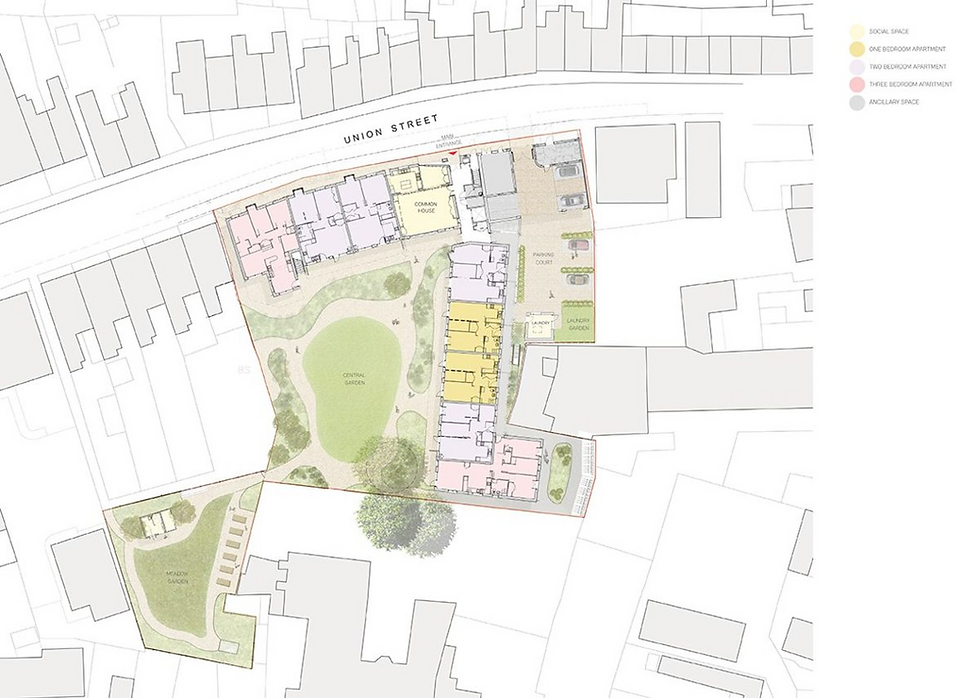
Image Credit: UK Cohousing
The Solution
The women hit on the idea of developing a housing community with shared facilities, which they would control. Like many transformative ideas that take a painfully long time to successfully manifest, the women reportedly spent 12 years searching for the right location around London to purchase and build the future they envisioned for themselves and others. Eventually, they found the right spot at St. Martha’s, a former convent school in the London suburb of High Barnet.
Like any design-build project, the transformation from a former school to a 25-unit, multi-family project included all the usual complexities and players. From funders, architects, contractors, and lawyers to local government employees and the local community, all contributed to standing up and launching the older-women-only, cohousing community that evolved from the group known as OWCH to the entity known as New Ground Cohousing (NGCH).
Interestingly, at the same time they were searching for the right location, OWCH members met once a month for a shared meal, took trips together, and intentionally engaged in community/team building activities to get to know each other ahead of preparing to live in close relationship with each other. Intentionality is one necessary aspect of building trust in a venture (and capitalism more broadly) that struck me as I was learning about OWCH and its evolution toward NGCH.
To help finance the renovation and reduce risk, prospective buyers in NGCH paid 10% deposits on their new homes. When the project was completed in 2016, 17 homes were sold to OWCH members, and the remaining eight units were set aside as rentals. All 25 homes were pre-sold or pre-let before construction started.
This is another aspect of trust that struck me. These 17 women came to the table with whatever assets they needed, often selling their current home in order to buy into NGCH, as tangible evidence of the trust they had in their vision and each other. This is categorically different from the trust one might have in merely placing one’s money in some traditional investment vehicle. These women were invested in their vision not just financially but with body and soul.
Talk about next level trust in launching and operating our businesses! Yes, all of us should have a good level of trust with our potential business partners, otherwise we’re foolish to go into business with them. But we typically go into our business relationships with an exit plan in mind. Also, unless our business partner is our spouse or child, that exit plan doesn’t typically include our business partner looking out for us as we inescapably age.
Ten years on, are these women still in good relationship with their venture and each other? The consensus appears to be “yes!” Of course, 26 people working and living together isn’t all rainbows and unicorns; neither is that the expectation. There are management and interpersonal disagreements among these seniors just like there has been since they were in kindergarten; but these women underwent formal conflict resolution training and have agreed to rules around consensus building and decision-making. As vacancies open, new members are similarly schooled to succeed.
As I read and learn of this particular business solution to solve this particular challenge, I see the role trust plays in ensuring that cohousing is a sustainable model. I was also reminded how trust is a critical element of every commercial exchange. When trust is present, the exchange is easier and more pleasant. When it’s not, it’s not.
For a robust read about current life at NGCH, check out this May 2026 article from the British newspaper The Times. In addition, check out these pages about OWCH beginning here, and these pages about NGCH beginning here.

Scaling the Solution
Like any business vision and solution, the inevitable question is, “Is it scalable?” Again, the consensus is “yes!" Cohousing is as ancient as our earliest cave-dwelling ancestors, so the question becomes, “How is it best contextualized in modern society and capitalism?”
Drawing from the UK perspective—as NGCH is located in metro London—I’ll point to what UK Cohousing Network observes, “Cohousing communities are intentional communities, created and run by their residents. Each household has a self-contained, private home as well as shared community space. . . .Cohousing is a way of resolving the isolation many people experience today, recreating the neighbourly support of the past. This can happen anywhere, in your street or starting a new community using empty homes or building new.”
Cohousing communities are formed on the basis of five primary principles, according to UK Cohousing Network. These are:
Codesigned with intentional communities
Includes both private and common spaces to facilitate privacy and community
Sized and scaled to support community dynamics for easy communal contact, usually 10-40 households
Embeds collective residential control and stewardship into its legal form and decision making
Inclusive and part of the wider community
UK Cohousing Network takes a closer look at the success of NGCH—including financing, construction, and operations—as an example of cohousing for the intentional community of older women here. More information from UK Cohousing Network about creating successful cohousing entities is available from its home page here.
Back to the underlying element of trust. The residents investing in cohousing aren’t focused on maximizing profit with their real estate deal. Sure, the operation must realize a balance sheet in the black as opposed to the red just like any operation, or it won’t be sustainable. But maximizing profit isn’t their only ethic, unlike much of the rest of modern capitalism.
Rather, by trusting in themselves and each other (their business partners) to claim and exercise the alternative ethics of mutuality and enough, they are able to create for themselves richer and fuller lives and by extension richer and fuller communities. Richer, fuller lives and communities is a vision and manifestation of a better capitalism.
Join Us
We write about capitalism done well and provide examples like OWCH because we collectively have the capitalism we create, and we can collectively create a better capitalism. We’d love for you to join us on this journey of renewing capitalism. You can begin by reading our book, Better Capitalism, and by signing up for our weekly blog post.

Fix Capitalism. Fix the American Dream.
Our vision is to benefit society by transforming capitalism's current core ethic of 'maximize shareholder value' to the better core ethic of 'optimize mutual value.' We achieve our vision by impacting learning, opinion, beliefs, and policy. Institute for Better Capitalism, Inc.
⭐⭐⭐⭐⭐ Our Amazon number 1 new release: Unleash more with Better Capitalism: Jesus, Adam Smith, Ayn Rand, & MLK Jr. on Moving from Plantation to Partnership Economics.
"This book merits close, sustained attention as a compelling move beyond both careless thinking and easy ideology."—Walter Brueggemann, Columbia Theological Seminary
"Better Capitalism is a sincere search for a better world."—Cato Institute
The Institute for Better Capitalism, Inc., is a 501(c)(3). We invite and are grateful for financial partners in this work. We invite you to donate here or contact us for more information. Thanks!


